Field guide

How Bed Bug Heat Treatment Works

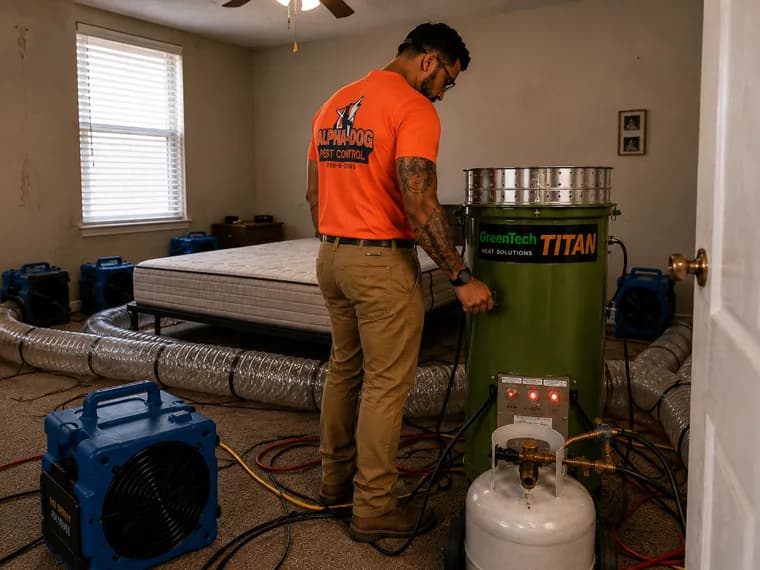
Bed bug heat treatment raises a whole room to roughly 135 degrees. Adult bed bugs die near 118 degrees, and their eggs are the heat-resistant stage, so the coldest crack in the room decides the outcome, not the air. Heat is a physical kill that reaches where a spray never lands. In Evansville and across Southern Indiana, Alpha-Dog Pest Control holds lethal heat a full 24 hours, sets up one day and shuts down the next, runs a professional chemical application with it, then has an independent canine detection team check the result.

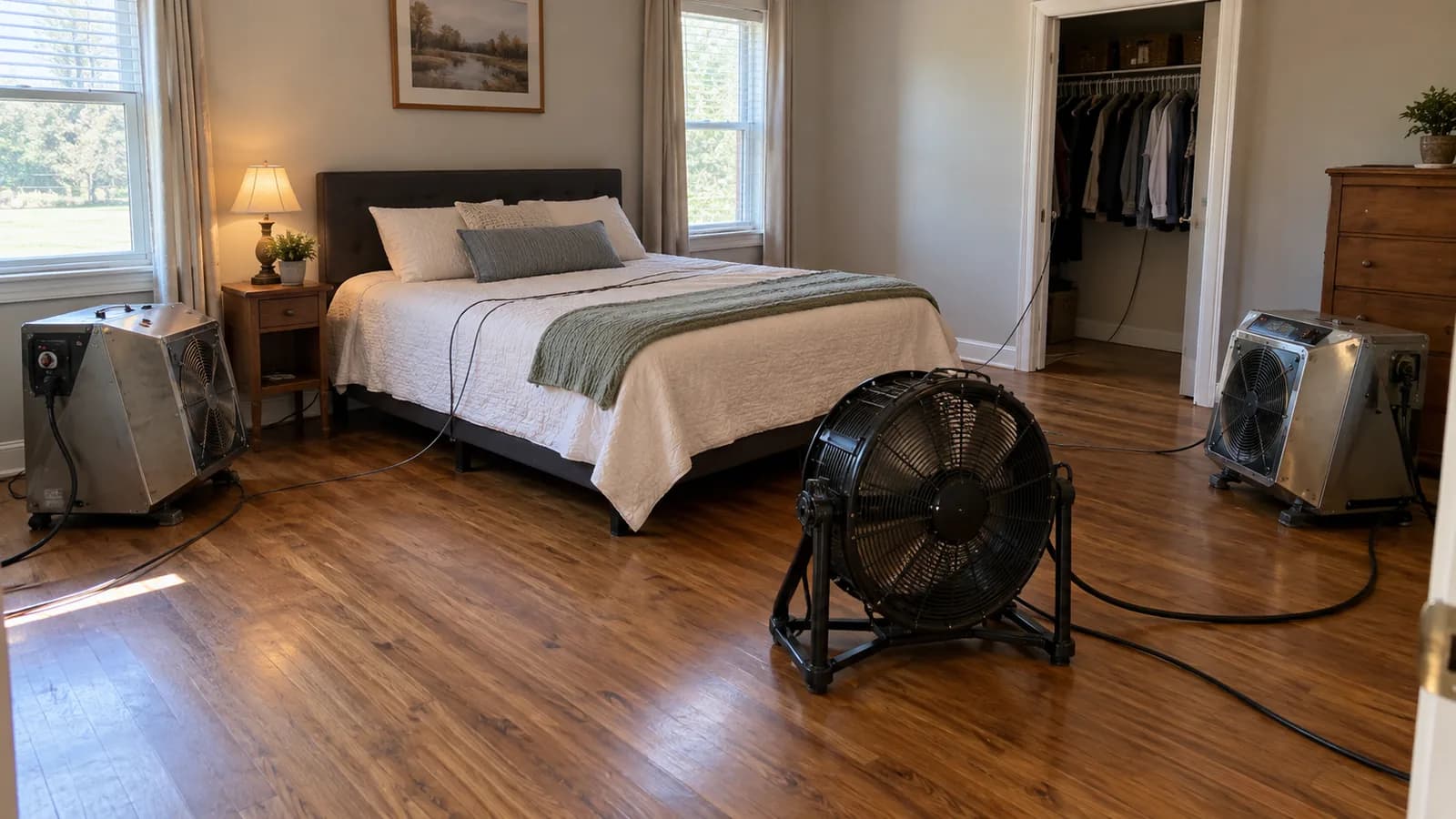
Heaters and sensors positioned in a bedroom at the start of a heat treatment cycle.

What Temperature Actually Kills Bed Bugs and Their Eggs
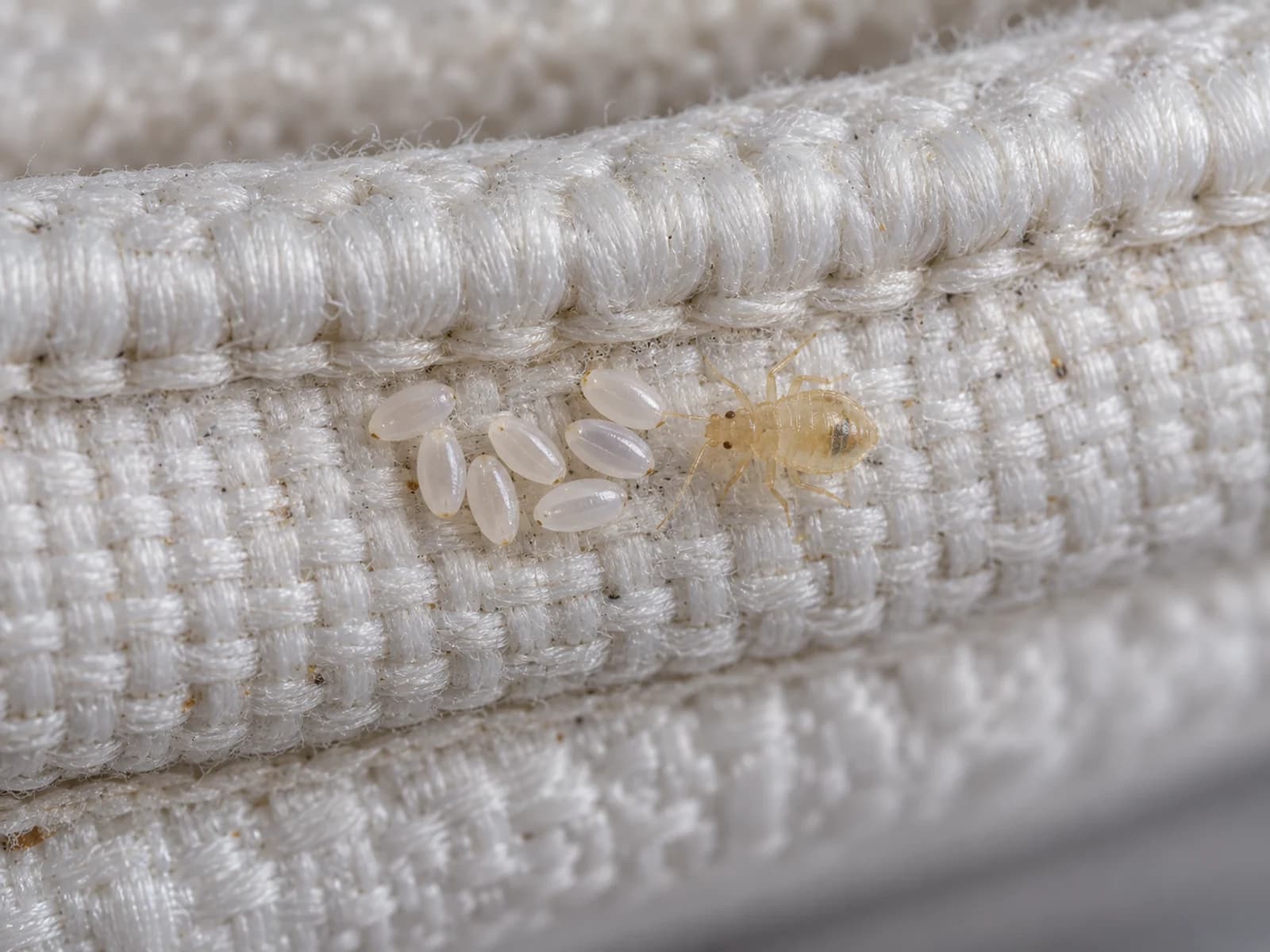
Cluster of tiny white bed bug eggs and a translucent nymph along mattress piping.

Most people want the number first, but the reasoning is what makes it mean anything. Adults and nymphs are the easy part. Virginia Tech's extension entomologists put their thermal death point at about 118 degrees F. Peer-reviewed work in the journal Insects (Kells and Goblirsch, 2011) landed there too, at an LTemp99 of 48.3 C, or 118.9 F.

The eggs are the hard part. Virginia Tech cites 122 degrees for them, and that same lab work put eggs at an LTemp99 of 54.8 C, roughly 130.6 F. Eggs survived seven hours at 45 C, then died in about 71.5 minutes at 48 C. Two things follow. Temperature does not decide the outcome alone, and lethal heat has to be held rather than touched.

That gap between adults and eggs is why professionals target 135 degrees ambient rather than the bare death point. The air reading is not the target. The coldest harborage in the room is, and it has to clear the egg threshold. Purdue University Extension, Indiana's land-grant entomology authority, puts effective control at 120 to 125 F (49 to 52 C).

Apply that to the short heating windows most of the market sells. Air heats fast. A mattress core, a stuffed chair and the back of a baseboard stay cool much longer. That is the physics behind our 24-hour hold, and behind does heat treatment kill bed bugs in one day.

Past your second spray? Call (812) 401-1028. The inspection is free and the quote comes in writing.
Why Spraying Alone Fails: The Chemical-Resistance Problem

You spray, they come back, you spray again. That cycle is documented, not bad luck.

The University of Kentucky's Martin-Gatton College of Agriculture, Food and Environment reported in 2006 that entomologists Kenneth Haynes and Michael Potter found bed bug populations resistant to pyrethroids by more than a hundredfold, some several thousandfold, against deltamethrin and lambda-cyhalothrin. Seven of eight field populations tested well above a hundredfold resistant. The researchers warned that resistance at that level may compromise the efficacy of pyrethroid products.

Purdue Extension Entomology, Indiana's science voice, states it plainly. Bed bugs "have developed an extraordinary resistance to most classes of pesticides," so "a chemical only approach is insufficient."

Purdue's conclusion is not an argument against chemicals. Purdue says the best programs combine targeted pesticide applications with nonchemical treatment options. That is the job we run across Southern Indiana: lethal heat plus a targeted chemical application on nearly every job. The failure mode is spray-only, not chemistry.

Heat is a physical kill. A bed bug can inherit resistance to a molecule. It cannot inherit resistance to 135 degrees.

Store sprays and bug bombs make it worse. They scatter a population deeper into wall voids and adjoining rooms, which makes the professional job harder.

Your real worry is a treatment that does not hold. The evidence says spraying alone is what does not hold.

How Whole-Room Heat Reaches Bed Bug Harborages

Heat treatment is not just a hot room. It is heat driven where you cannot see.

Professional heaters and high-volume fans raise the whole-room air and drive convective heat into voids. The industry runs electric or propane. Ours is electric, held a full 24 hours.

Virginia Cooperative Extension publication ENTO-583, from Virginia Tech, makes the key point. Ambient air temperature alone is not the measure. The cracks and crevices themselves must reach the lethal threshold, which that publication puts at 122 degrees F for eggs. Purdue Extension gives an effective range of 120 to 125 degrees F.

So the crew keeps moving. The same guidance calls for repositioning heaters, fans, and ducting roughly every 20 minutes. We aim the air at floor-to-wall junctions, baseboards, and furniture cavities. Airflow is not a detail. Still air stratifies and leaves the floor line cool, which is exactly where bed bugs live.

Bed bugs try to flee rising heat. Convection plus a sustained hold removes the cool refuge. Hold time matters more than peak temperature.

In shared-wall apartments and hotels around the Evansville metro, those cold spots are common. If you are not sure what you have, read the signs of bed bugs.

Heat is not always the right tool. In large open spaces and facilities like doctors' offices, you cannot hold an envelope at temperature. Those jobs become a chemical treatment, or steam plus chemical. Heat is our preference, not our only method.

The inspection is free and the quote is written. Call (812) 401-1028.

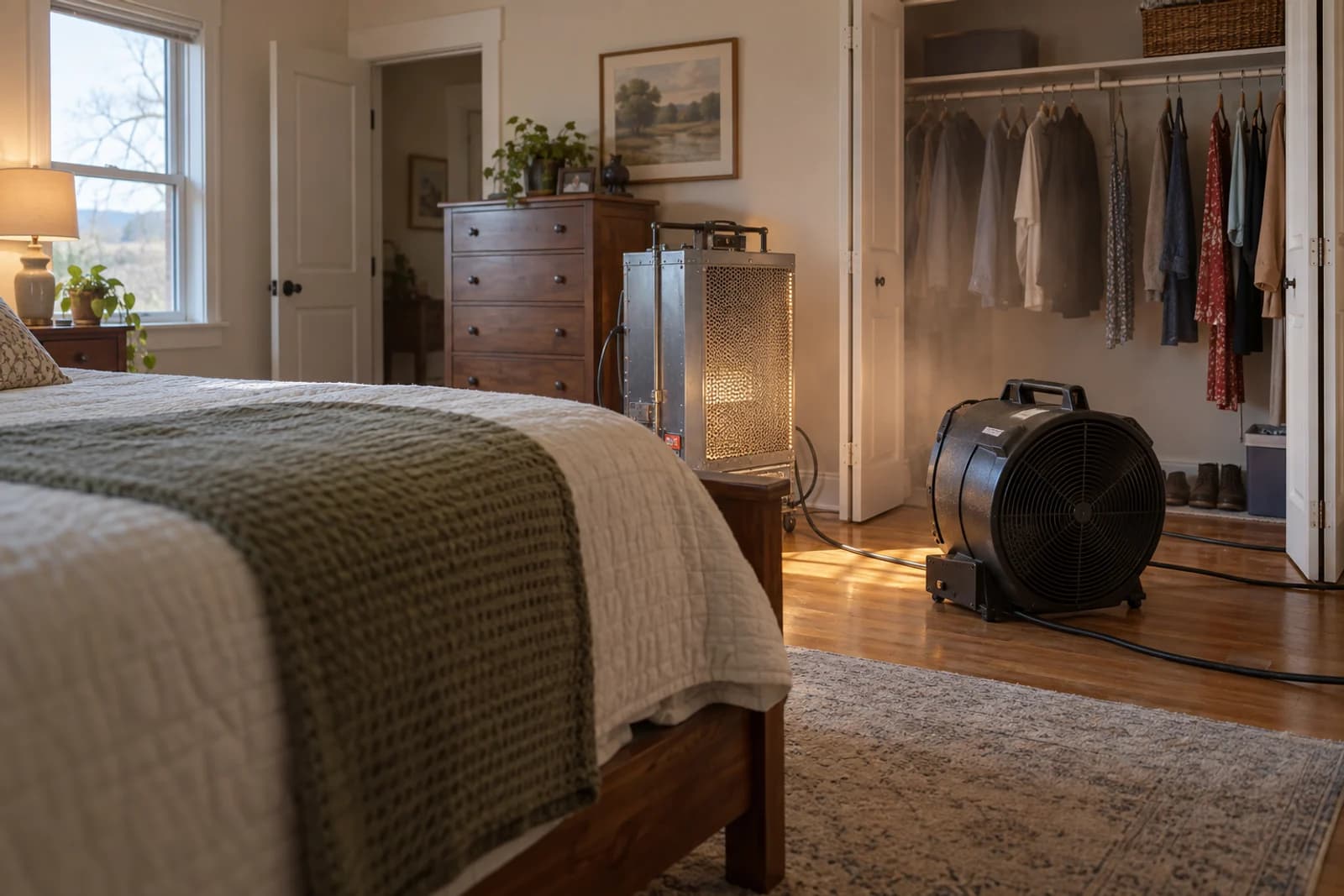
Air mover directing heated air into an open closet during a whole-room heat treatment.

Sensor Placement and Real-Time Monitoring

Wireless temperature sensors go where the room fights back hardest. Deep inside furniture. Wall junctions. Closet floors. Never in open air. A sensor sitting in hot air only confirms the air is hot. It says nothing about the mattress core or the baseboard void where the bugs actually are. That placement decision is the whole point.

Technicians watch the live readings and keep moving heaters and fans until every sensor crosses the lethal target and holds it. Crossing is not holding. The marks are the numbers above: roughly 135 degrees F ambient, past the 118 degree adult death point and the higher egg threshold.

Readings and photographs record that every monitored location reached bed bug lethal temperature. That is the paper trail behind the claim.

The EPA is blunt about the alternative: do not try to kill bed bugs by raising indoor temperature with a thermostat, propane space heater, or fireplace. It does not work and it is dangerous. A space heater cannot hold an envelope, and it cannot tell you what the inside of a wall void is doing. Professionals, the EPA notes, have access to more intensive and proven methods that can heat whole houses.

Technician checking a handheld display of wireless temperature sensor readings.

What a Treatment Actually Looks Like, Day One to Day Two

Zach still likes to take the first visit himself, because that is how the job gets scoped right. He checks mattress seams, box spring, headboard and baseboards, then tells you what he found. You get a confirmed arrival window and a call-ahead before we roll.

Day one, heaters, air movers, and sensors go into your Evansville or Newburgh home. The target is 135 degrees. Lethal heat holds a full 24 hours: the coldest harborage decides the outcome, and a mattress core takes time to pass the egg threshold. Published literature puts the market's standard at 4 to 5 hours of active heating in a 6 to 10 hour window. We hold longer.

Day two, we return, shut it down, and run the chemical application that goes with heat on nearly every job. Heat runs alone only if you are against chemicals outright.

Most belongings stay put. Out come heat-sensitive items, aerosols, candles, lighters, pets, plants, and certain medications. See how to prepare for a heat treatment.

Before we leave, we walk you through what we found and did.

How Alpha-Dog Verifies the Bed Bugs Are Actually Gone

Heat fails in one specific way. It fails at a cold spot.

A room can hit target while a baseboard or wall void never gets there. Bed bugs move away from heat, into framing where it stays cool, and heat does not penetrate walls with complete reliability. What settles the question is the coolest pocket in the room, not the reading in the hallway.

We close that gap three ways. First, time: we hold lethal heat a full 24 hours instead of a four-hour pass, so slow spots have a day to catch up. Second, measurement: sensors go in the cold spots rather than in open air, and we watch them live. Third, an independent canine detection team inspects the home afterward. They are not our people.

Trained detection dogs work at scent levels a visual check misses, including live bugs and viable eggs. The industry's sharpest criticism of heat is the unverified survivor, and the usual answer is more chemical. Ours is proof. We do not grade our own homework, and no other company here sells outside confirmation that a treatment worked.

On a bed bug job, "gone" means the tri-state canine team cleared the home, not our opinion. We keep coming back until the bed bugs are gone, and the 30-day warranty starts from that clearance, not from treatment day.

Ask any company how a job gets closed out. Ours closes with a canine team that does not work for us. Call (812) 401-1028.

Aftercare: Keeping Bed Bugs From Coming Back

Heat leaves no chemical film. Once the room cools, that protection is over. Purdue Extension says as much: heat has an immediate and substantial effect but does not provide long lasting control. What holds is a complete verified kill plus the chemical application that runs with the heat.

When bed bugs show up again, it is usually reintroduction, not a failed treatment. They are hitchhikers. They came in on something: a suitcase, a used couch, a guest. Bed bugs don't care if your house is clean or dirty. In Evansville apartments and hotels, that pressure never stops.

Prevention is simple. Inspect luggage and secondhand items before they come inside, use mattress encasements and monitors, and in a multi-unit building report a sighting early. The key is consistency, not one heroic cleanup.

If anything turns up, we keep coming back until the bed bugs are gone. Your 30-day warranty starts at the canine clearance, not treatment day, and bed bug work is the one service that carries it. The window is short for a specific reason: bed bugs are an introduced pest and can be brought back in from wherever they were picked up. Nobody can warranty a suitcase. If you are weighing the cost, here is how much bed bug heat treatment costs.

Frequently Asked Questions

How long does a heat treatment take?

Day one is setup. We hold lethal heat a full 24 hours and return the next day to shut it down. The market's standard is 4 to 5 hours of active heating. That is not ours.

What if I cannot be out of the house for 24 hours?

Then we run a different method rather than a shorter version of this one. A propane treatment brings the time you are out down to 8 hours. If that is still too much, a steam and chemical treatment asks for 4 to 6 hours. Both are genuine options and both get scoped to the building, but neither reaches into a mattress core and a wall void the way a full 24 hours of held heat does. That trade-off is yours to make with the facts in front of you, which is why we put them here.

Does heat treatment kill bed bug eggs?

Yes. Eggs are the heat-resistant stage. Kells and Goblirsch put the egg threshold near 130 degrees, well above the roughly 118 that kills adults. So we target 135 ambient and hold it.

Do bed bugs come back after heat treatment?

Heat leaves no residual. A correct whole-room treatment kills every life stage present that day. Bugs found later are almost always cold-spot survivors or a reintroduction. On a bed bug job the 30-day warranty starts at canine clearance.

Can I do it myself with a space heater?

No. The EPA says raising indoor temperature with a thermostat, propane heater, or fireplace does not work and is dangerous. You cannot seal a room or read a wall void. A clothes dryer on high works on items.

Why do some heat treatments fail?

Cold spots. Wall voids, baseboards, and dense furniture where lethal temperature was never reached. So sensors go in the cold spots, and an independent inspection follows.

Do I have to move everything out?

No. Most belongings stay and get treated in place, a real advantage of heat. Heat-sensitive and air-sensitive items go out: electronics, aerosols, candles, lighters, pets, plants, and certain medications.

Zach Krietemeyer, owner of Alpha-Dog Pest Control.

Zach Krietemeyer

Owner

What Heat Treatment Comes Down To

Lethal heat, held a full 24 hours, with a professional chemical application running alongside it. Then an independent canine detection team inspects the dwelling and reports what they find. They do not work for us, so they have no stake in the answer. That inspection is for bed bug jobs only.

We have served Evansville and Southern Indiana since 2020. If you think you have bed bugs, do not wait. They are easier to clear before they spread through the house.

Call (812) 401-1028 and we will set an arrival window. You can also read more on Bed Bug Control and Heat Treatment or Bed Bug Heat Treatment in Evansville.

Get a free quoteCall (812) 401-1028Call now

Free QuoteCall NowPhones answered after hours